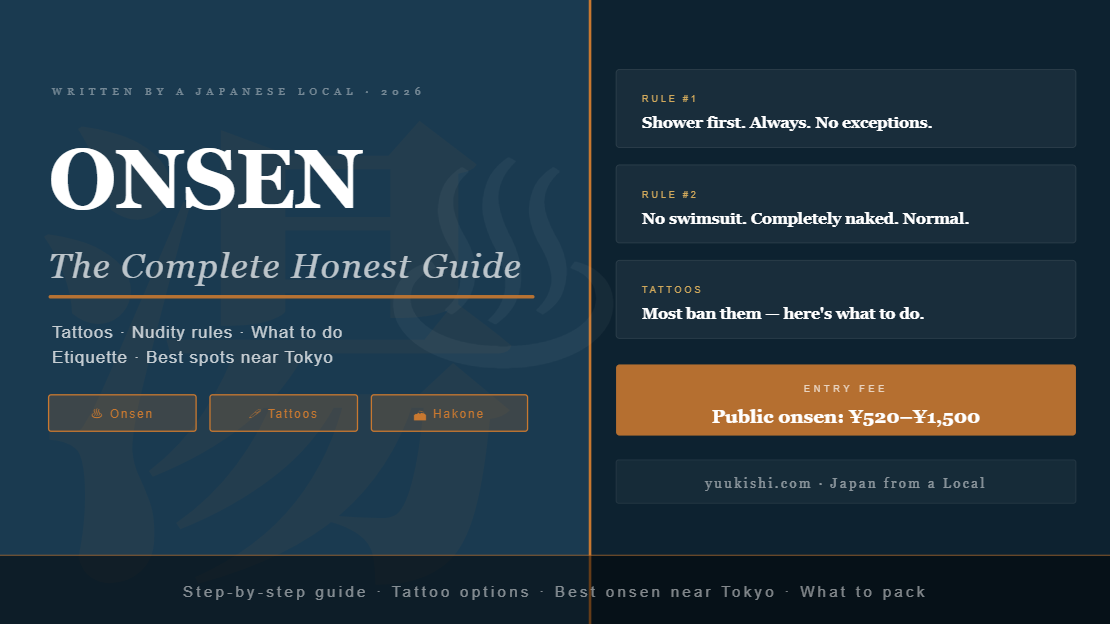
The honest guide to
Japanese Onsen.
Tattoos. Nudity. What to wash first. Which door to enter. There’s a lot to know — and most guides get it wrong or leave things out. Here’s what we actually do.
Onsen vs Sento: what’s the difference?
Onsen (温泉) — a bath fed by natural geothermal spring water. The water contains minerals (sulphur, iron, carbon dioxide depending on the source) and is considered therapeutic. Usually found in mountains, coastal areas, or volcanic regions. The big experience. What most tourists are looking for.
Sento (銭湯) — a public bathhouse using heated tap water, not natural spring water. Found in cities and residential neighbourhoods. Cheaper (around ¥520 in Tokyo). Less “scenic” but a more genuinely local, everyday experience. Many older Japanese people use their neighbourhood sento regularly.
Super Sento — a large modern sento with multiple bath types, saunas, relaxation areas. Often has jet baths, carbonated baths, and various themed pools. More like a spa complex. Good foreigner-friendly option as they tend to have clearer signage.
In Tokyo you’ll mostly find sento, not true onsen — the city isn’t near enough to geothermal sources. For a real onsen, take a day trip or overnight trip to Hakone (90 min from Shinjuku), Nikko, or Atami. Or go further to Beppu or Kinosaki Onsen for a full traditional experience.
Step by step: exactly what to do
At the entrance, pay at a vending machine or counter. You’ll usually get a small towel and a locker key. At a ryokan, your room key often doubles as the onsen key. Look for 男 (men) and 女 (women) signs — red curtain (noren) is usually women, blue is men, but always check the kanji.
Put everything — including underwear — in your locker. Bring your small towel into the bath area with you (but keep it out of the water). Don’t be self-conscious. Everyone is in exactly the same situation and nobody is looking at you.
This is mandatory. Sit on the small stool at one of the shower stations along the wall. Use the soap and shampoo provided (or bring your own). Wash your entire body and rinse off completely. Don’t splash neighbouring bathers — keep the showerhead low.
Japanese onsen are hot — typically 40–44°C (104–111°F). Enter slowly and give your body a moment to adjust. Don’t jump or splash. Place your small towel on top of your head or on the edge of the bath — never let it enter the water.
Keep your voice low. No phone calls. No phones in the bath area at all (cameras are obviously forbidden). If there are multiple pools (hot/lukewarm/cold), you can move between them. Drink water beforehand — the heat can dehydrate you quickly.
Use your towel to dry off before returning to the changing room — don’t drip on the changing room floor. Many onsen have hair dryers, body lotion, and other amenities provided. Take your time. This is the point where you’ll feel the full relaxation effect.
The tattoo question: honest answer
Most traditional onsen still ban tattoos. This isn’t arbitrary — it comes from a historical association between tattoos and organised crime (yakuza). The rule is fading, especially in tourist areas, but it hasn’t disappeared. Attitude varies hugely by establishment and region.
What are your options? (1) Look for tattoo-friendly onsen — search “tattoo OK onsen” + your destination. There are now dedicated lists online and they’re growing. (2) Book a private bath (貸切風呂, kashikiri buro) — you rent the entire bath for your group. Tattoos are almost always fine in private baths. (3) Cover small tattoos with waterproof bandages or stickers — some onsen permit this, but ask first. (4) Use a hotel onsen in a foreigner-friendly hotel — they’re more likely to have relaxed rules.
Don’t try to hide a large tattoo and get in anyway. It creates an awkward situation for everyone and you may be asked to leave.
Do’s and Don’ts — the complete list
Types of onsen and what each feels like
The classic image: soaking in hot spring water while surrounded by nature. Mountains, snow, bamboo, or ocean views. The absolute pinnacle of the onsen experience.
A traditional inn with its own onsen. Usually included in the room rate. More private, high quality. Often the most memorable onsen experience for first-timers.
Reserve the entire bath for your group (couples, families). Usually an extra charge. The best option for those with tattoos or who are not comfortable with communal bathing.
The local, affordable, everyday option. ~¥520 per visit. Not natural spring water but the same bathing culture. A genuinely local experience in city neighbourhoods.
Milky white or yellow water. Strong egg smell. Famous for skin and respiratory benefits. Noboribetsu (Hokkaido) and Kusatsu (Gunma) are the most famous examples.
Smooth, soft water said to be wonderful for skin. Called “bijin-no-yu” (beauty water) in Japan. Ureshino Onsen in Saga prefecture is legendary for this.
What to bring — and what not to bother with
Almost everything is provided — towels, toiletries, a yukata (light cotton robe) to wear around the inn and to the onsen. You don’t need to bring anything except your own body. The yukata is for wearing around the property, not outside.
Where to go — local recommendations
90 minutes by Romancecar train from Shinjuku. Dozens of ryokans and day-use onsen facilities with views of Mt. Fuji (when clear). Hakone Yuryo and Tenzan are excellent foreigner-friendly day-use options. Book in advance on weekends.
A small traditional onsen town where you wear yukata in the streets and hop between 7 public bathhouses (sotoyu-meguri). This is the closest thing to experiencing onsen culture as it has existed for centuries. One of my personal favourites.
Beppu produces more geothermal water than anywhere else in Japan. The “Jigoku Meguri” (hell tour) shows you dramatically coloured boiling pools. Extremely foreigner-friendly city with many English-language resources.
A large sento/spa facility in Kabukicho, Shinjuku. Uses natural spring water brought in from Niigata. Multiple indoor and outdoor baths. Good English signage. Tattoos permitted in private rooms and some areas. Open until 9am — perfect after a night out in Shinjuku.
One of Japan’s most famous onsen towns, known for its yubatake (a field of hot spring water being cooled outdoors in the town centre). The acidic sulphur water is said to “cure everything except lovesickness” — a Japanese saying. About 4 hours from Tokyo.