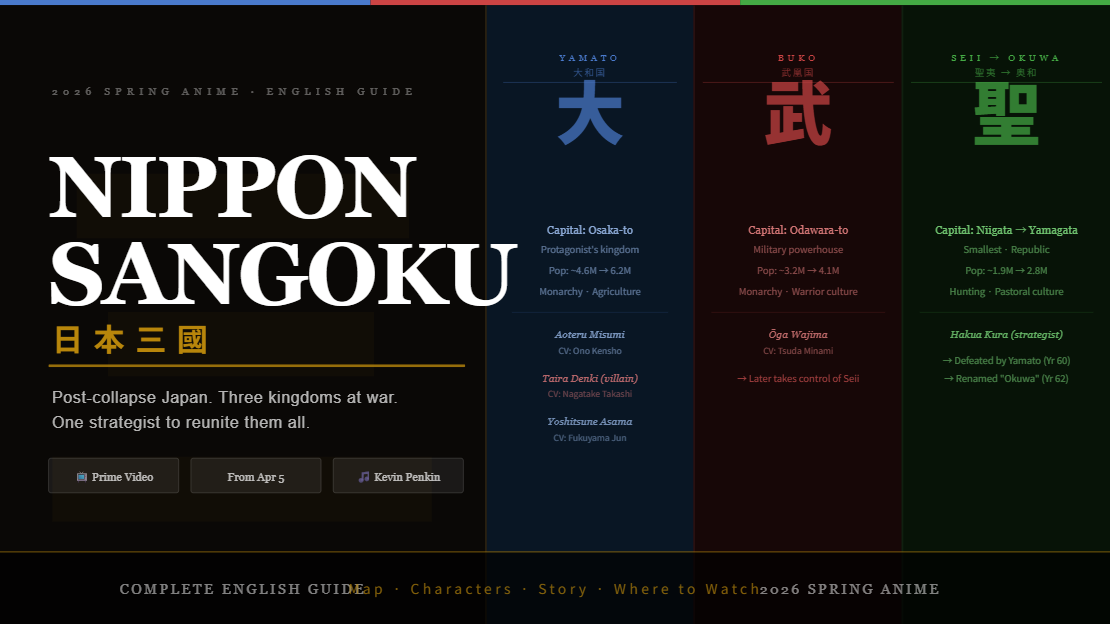
NIPPON SANGOKU
Japan has collapsed. Three kingdoms now control what remains of the country. One man — a humble rural official — aims to reunite them all using only his intellect and words. Here’s everything you need to understand this extraordinary anime.
The 30-second pitch: Japan’s Three Kingdoms era
Nippon Sangoku (日本三國, literally “Japan Three Kingdoms”) is a 2026 spring anime based on a manga by Ikka Matsuki, serialised in Shogakukan’s MangaOne platform since 2021. It’s a political war epic set in a near-future Japan that has suffered total civilisational collapse — and been split into three rival kingdoms.
Think of it as Japan’s answer to Romance of the Three Kingdoms — the ancient Chinese classic about the warlords Cao Cao, Liu Bei and Sun Quan — but transposed onto a destroyed modern Japan. The protagonist isn’t a warrior but a strategist who fights with intelligence and rhetoric rather than swords. If you loved Zhuge Liang in Three Kingdoms, you’ll understand the appeal immediately.
Original manga by Ikka Matsuki, serialised in MangaOne and Ura Sunday (Shogakukan) from November 2021. Cumulative circulation exceeded 1 million copies as of March 2026. Previously adapted into a stage play in 2025. The anime is co-produced with Amazon MGM Studios.
How did Japan collapse? The backstory
The show is set roughly 100 years after a cascading series of catastrophes in the late Reiwa era (modern Japan). This isn’t fantasy — it’s a believable near-future dystopia built on real-world risks pushed to their extreme.
A worldwide nuclear exchange destroys undersea cables and digital networks. Japan’s internet-dependent society collapses overnight. International supply chains sever.
A virus deadlier than COVID-19 spreads through refugee populations. A mega-earthquake beyond the scale of 2011 devastates the coast. Crop failures and corrupt taxation trigger a violent popular revolution.
Japan’s population drops to less than one-tenth of its peak. Civilisation regresses to roughly Meiji-era (1870s) technology. The country fractures into three rival states.
About a century after collapse. The protagonist, Aoteru Misumi, is a minor agricultural official in Ehime Province, Yamato Kingdom. The story starts here.
Unlike fantasy anime with invented civilisations, Nippon Sangoku’s collapsed Japan still has recognisable geography — you can match the kingdoms to real Japanese prefectures. The Osaka headquarters, the Kanagawa capital, the Niigata border. This groundedness makes the world feel genuinely unsettling rather than escapist.
Where each kingdom controls on the map
The three kingdoms, explained clearly
“Yamato is the largest but rotten from within. Buko is powerful but blunt. Seii is small but hungry — and hunger makes people dangerous.”
Who to know before you start watching
Yamato Kingdom
A humble agricultural official in rural Ehime Province, Yamato. He has no army, no sword, no title — only deep knowledge of pre-collapse civilisation and an extraordinary gift for rhetoric. His wife is executed by the villain at the story’s start, turning his life into a mission to reunite all of Japan. Born Yamato Year 41.
The de facto ruler of Yamato. Emperor Fuji III, installed at age 4 after Denki poisoned his own predecessor, is a puppet. Denki is not a raving tyrant — he’s a brilliant, terrifyingly competent autocrat who simply kills anyone who inconveniences him. Born Yamato Year 5, Osaka.
Aoteru’s closest companion and rival — 3 years older, from an old military family. He’s everything Aoteru isn’t physically: a superb fighter with tremendous tactical instinct. But his elite pride means he never fully accepts Aoteru as an equal. Later marries Taira Denki’s daughter, placing him inside the enemy’s family while still working against them.
The frontier general who recognises Aoteru’s genius at a civil service exam and appoints him. Lost his left eye at 17 defeating 100 bandits with a handful of men — a man of legendary integrity and physical courage. Born Yamato Year 5, Hyogo Province. He becomes the first patron who gives Aoteru a stage.
Taira Denki’s chief strategist. Extremely intelligent, fastidiously hygienic (he always carries soap), and present at the execution of Aoteru’s wife — making him personally connected to everything Aoteru wants to undo. His interests in shōgi and kemari betray a mind that treats life as a game.
Buko & Seii Kingdoms
A military general who first serves Buko, then seizes total control of Seii after an internal coup. Determines that the only way to reverse Seii’s decline is to conquer neighbouring territory — setting her on a collision course with Aoteru’s Yamato forces. One of the story’s most formidable strategic opponents.
The strategist who matches Aoteru in intellect — the closest thing the story has to an equal genius on the opposing side. Commands Okuwa’s military think-tank and executes strategies that Yamato struggles to anticipate. The intellectual duel between Kura and Aoteru is one of the show’s central pleasures.
How the kingdoms relate to each other
The key relationship to understand is that Yamato is simultaneously the story’s home base AND its central problem — the villain Taira Denki rules Yamato, meaning the protagonist and antagonist share the same kingdom. Aoteru is trying to remove the man who controls his own country before he can even think about uniting the others.
Meanwhile Buko is the external military threat Yamato must eventually face, while Seii becomes something of an intermediate conflict — smaller than Buko, but the invasion of Seii (and its conversion into the puppet state “Okuwa”) demonstrates what Yamato is capable of under strategic leadership.
How to watch, and what to expect
Co-produced with Amazon MGM Studios, so Prime Video is the global home. English subtitles available. If you have Prime membership, there’s no extra cost. This is the fastest and most accessible option for international viewers.
Traditional TV broadcast in Japan. Also simulcast on U-NEXT (Japan) from April 6. For international viewers, Prime Video is the recommended path.
The first episode moves deliberately — it takes its time establishing a peaceful life before dismantling it. Don’t skip the opening 15 minutes. The quiet domestic scenes with Aoteru and his wife are doing important work. The show earns its tragedy rather than rushing it. Stick with the first two episodes before deciding whether it’s for you.
Opening theme: “Hidane” (火種, “Fire Seed”) by Kitani Tatsuya — a singer-songwriter known for emotionally precise, slightly dark indie pop. Perfect match for the show’s tone.
Ending theme: “Chikai” (誓い, “Vow”) by Leina.
Soundtrack: Composed by Kevin Penkin, the Australian-Japanese composer behind Made in Abyss and Re:Zero. Expect something sweeping and emotionally devastating.